
Learn sidemount diving with control and a strong foundation
Sidemount diving is much more than attaching two cylinders beside your body. A good sidemount course teaches you how to configure the complete system, stay stable in the water and safely use the advantages of two independent gas supplies.
At Sidemount Academy in Belgium, the focus is on configuration, trim, buoyancy, finning techniques, gas management and control. You develop skills that you can use in recreational, technical and cave diving.
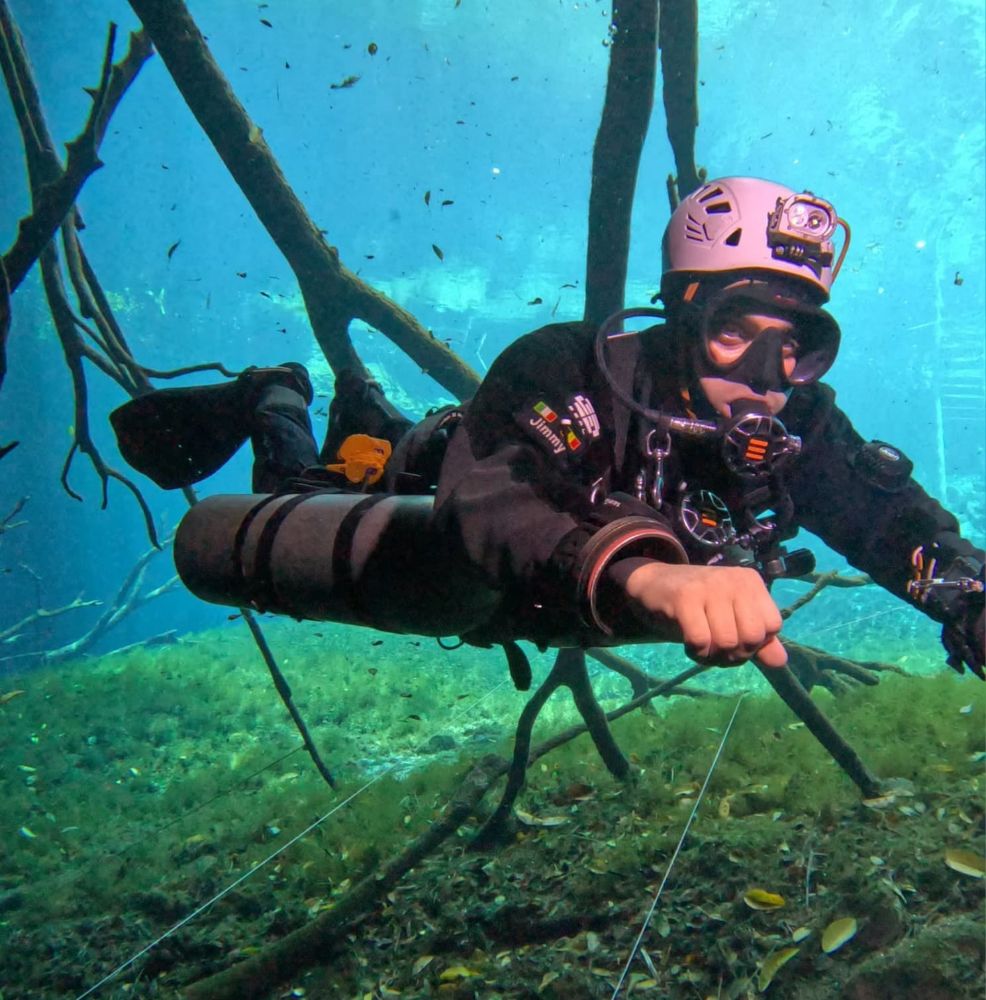
A complete sidemount course
- Setting up your harness, wing and cylinders
- Trim and buoyancy
- Efficient finning techniques
- Gas management
- Working with two independent regulators
- Critical skills and scenarios
What is sidemount diving?
In sidemount, you carry your cylinders beside your body rather than on your back. Each cylinder has its own regulator, so you dive with two completely separate gas supplies. You can attach, check and, when needed, reposition each cylinder independently.
A properly adjusted sidemount configuration can give you a streamlined position, easy access to the valves and two independent gas supplies. You can also carry the cylinders to the water one at a time and clip them on once you are in the water.
Sidemount does ask for a different way of diving. You monitor two pressure gauges, switch regulators at set points during the dive, and the equipment has to be fitted precisely to your body. That is why the first dives often feel unfamiliar. The benefits only show once you are in control of the configuration, which is why the course puts so much emphasis on the fundamentals.
How does the sidemount course work?
The RAID Sidemount Fundamentals course combines online theory, equipment configuration, confined water training and open water training dives.
Theory and workshop
You complete the online theory through the RAID learning platform. During the workshop, we discuss the configuration and carefully adjust your harness, wing, cylinders and regulators.
We look not only at where each component is attached, but also at how its position affects trim, accessibility and freedom of movement.
Confined water training
In confined water, you build control of the configuration. You practise trim, buoyancy, finning techniques, cylinder handling and switching between both regulators.
New skills are combined with a stable position and controlled movement.
Applying your skills in open water
During the open water dives, you refine the techniques in a realistic environment. You apply gas management, communication and critical skills in different scenarios.
The goal is not simply to wear the system, but to have genuine control over it.
Sidemount Fundamentals or Sidemount Basics?
Not every diver starts with the same level of experience. That is why we first assess which course format best matches your current skills.
Sidemount Fundamentals
Sidemount Fundamentals is the complete programme for divers who want to develop a technically strong foundation. It covers trim, buoyancy, finning techniques, configuration and critical skills in detail.
This format suits you if you want to learn sidemount thoroughly and are prepared to invest enough time in developing your skills.
Sidemount Basics
Sidemount Basics is a shorter option within the same course, for divers who already have strong fundamental diving skills. You need to be in control of your current configuration and show good trim and buoyancy.
We decide which option is right for you during a preliminary conversation and, when necessary, an evaluation dive.
Who is sidemount suitable for?
Sidemount suits recreational and technical divers who want to expand their configuration and skills. You do not need to be a cave diver to benefit from sidemount.
Some divers choose sidemount for the valve access, the independent gas supplies or the ability to carry cylinders separately. Others use it to prepare for technical or cave diving courses.
The sidemount course itself is not a decompression course and does not qualify you to enter caves or other overhead environments. These activities require separate training with their own entry requirements.
Equipment and configuration
A sidemount system consists of several components that must work together. The position of the harness, wing, weights, attachment points, cylinders and regulators affects your position in the water and your access to the equipment.
For regulators, we recommend most divers a set with one short and one long hose, such as the Tecline R2 TEC2 Side Mount Set. If you deliberately want to dive with two short hoses, the Tecline R2 TEC2 Side Mount Extreme Set is the alternative. It is a different hose configuration, not a better or heavier duty version.
The right wing and harness depend on how and where you dive. The XDEEP Stealth 2.0 Rec set is designed for recreational sidemount with up to two cylinders. The XDEEP Stealth 2.0 Classic set is a versatile choice that is also used for cave diving, and the XDEEP Stealth 2.0 Tec set is intended for technical diving with additional cylinders.
During the workshop, we help you select and adjust your equipment. If you already own a sidemount system, we check beforehand whether it is complete and suitable for the course. Planning to buy equipment? Talk to us first, so you get advice that fits your body type, experience and future diving goals.
From recreational sidemount to technical or cave diving
A solid sidemount foundation can later be used during recreational, technical and cave diving courses. Each next course has its own objectives, entry requirements and required experience.
If you want to dive deeper or make decompression dives, courses such as RAID Deep 40 and RAID Decompression Diver are possible next steps. Cave diving requires a separate cave course, such as RAID Cave 1. You can read more on our cave diving page.
We are happy to help you plan a realistic training path that matches your current level and future goals.
Ready to learn sidemount?
Would you like to start RAID Sidemount Fundamentals, or first discuss which option best matches your current experience? Contact us and we will look at your goals, equipment and possible schedule together.
Sidemount diving FAQ
Do I need sidemount experience before starting?
No. The course teaches sidemount from scratch. You should, however, feel at ease in your current gear and already be able to hover reasonably steadily.
Do I need my own sidemount equipment?
We agree on this before the course. If you bring your own gear, we check that nothing is missing and that everything works properly. If you have nothing yet, get in touch before you buy anything.
That way you avoid spending money on parts that do not suit your build or your plans.
Can I learn sidemount without planning to cave dive?
Yes. Many divers simply use sidemount on recreational dives in lakes and quarries, because the valves are easy to reach and each cylinder can be taken to the water on its own.
What is the difference between Fundamentals and Basics?
Fundamentals is the full programme in which we build a complete sidemount foundation. Basics is shorter and meant for divers who already have trim, buoyancy and the main finning techniques well under control.
We discuss which option suits you in advance.
Where do the training dives take place?
Confined water training takes place, depending on the schedule, at the municipal swimming pool in Temse or at Wetfun in Limburg, and sometimes at Put van Ekeren. Open water dives normally take place at Put van Ekeren or at another suitable location in Belgium agreed with your instructor.
How much time should I allow for the course?
The complete Sidemount Fundamentals course consists of online theory, one workshop day, 3 to 4 confined water dives and 3 to 4 open water dives, so 7 to 8 training dives in total. Sidemount Basics is shorter, with 5 to 6 training dives. Dates are planned in consultation with you.
Each training dive is a complete dive with enough time to practise the skills calmly and correctly.
Which certification will I receive?
Once you have completed the online theory and exams and your instructor has signed off all required skills, you receive an electronic RAID Sidemount Diver certification.
Can I make technical dives after this course?
No. The sidemount course teaches you a configuration, but it does not certify you for decompression dives, greater depths or diving under a ceiling. For that, you take separate courses and build up additional experience.