
Learn cave diving with knowledge, discipline and respect for the environment
Cave diving takes more than good basic skills and the right equipment. You need to learn to recognise risks, plan conservatively and make sound decisions under pressure.
At Sidemount Academy, we do not train cave divers who want to go further or deeper as quickly as possible. We build a strong foundation and teach you to make responsible choices within your training, your experience and your personal limits.
Our training path runs from Cavern to Cave 2. Each step adds new skills, responsibilities and complexity, and you only move on once your foundation is solid enough. You are not on your own after the course either: we support you during your first cave dives.
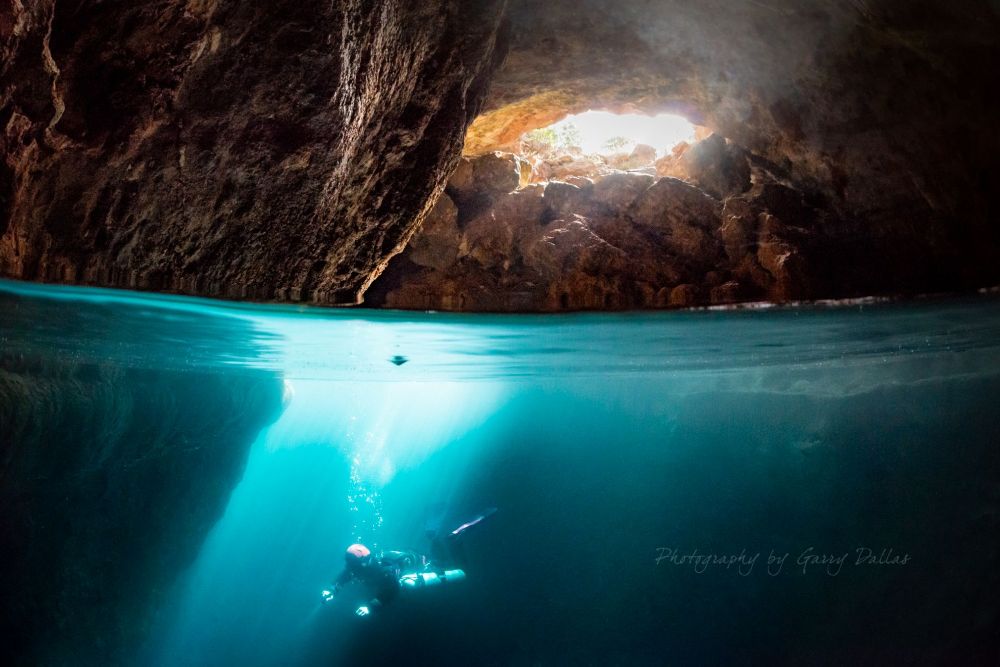
A sustainable path from Cavern to Cave 2
- Fundamental skills and control
- Conservative gas planning
- Line work and navigation
- Communication and teamwork
- Problem solving in an overhead environment
- Respect for the cave and its limitations
- Support during your first cave dives after the course
No cowboy mentality, but a solid foundation
A cave is no place for improvisation, haste or macho behaviour. A mistake that stays manageable in open water can have far greater consequences in a cave. You cannot ascend directly to the surface, and the exit may be a considerable distance away.
That is why our focus is not on how quickly you reach a certain distance. We look at the quality of your execution, your situational awareness, your communication and the decisions you make along the way.
A good cave diver has nothing to prove. They recognise when a plan needs to change, when a dive should be turned and when conditions do not match their own level or that of the team.
Lead instructor Jimmy Wuytack has been cave diving since around 2017. He is a member of the Mine Exploration Team, the only Belgian team that works officially with the Walloon government and the DNF to map abandoned mines. You can read more about his background on Jimmy Wuytack's instructor page.
From open water training in Belgium to the cave
A cave diving course with us usually starts in Belgium. We first work on the relevant skills in open water before applying them in a real cave.
There, we can work in a controlled way on trim, buoyancy, finning techniques, team position, communication, line use and problem solving. The instructor can observe your execution closely and give targeted corrections.
Open water also gives you room to repeat new procedures without the added load of an overhead environment straight away. That way, you do not have to deal with new techniques, restricted space, navigation and mental pressure all at once inside the cave.
Fundamentals in open water
We check your configuration and build the required skills in open water. You work on a stable position, controlled propulsion, communication and precise procedures.
Skills are not only performed in isolation. You learn to combine them while staying in control of depth, trim, team position and surroundings.
A controlled introduction to the cave
Once your foundation is strong enough, we move the training to a suitable cave. The first penetrations are deliberately kept simple and build on the skills you practised earlier.
You learn to recognise and experience the transition from open water to an overhead environment without the complexity increasing too quickly.
Exploring in successive steps
We build up distance and complexity gradually. Each new step starts from a familiar situation and adds only a limited number of new elements.
Your comfort grows without vigilance giving way to overconfidence. Later, you can use the same approach on your own when you explore an unfamiliar cave.
Exploring the cave without losing control
A cave does not become familiar ground in one go. Good cave divers get to know a system step by step and always keep a clear mental picture of the way out.
Building comfort through repetition
During the first dives, we explore a limited and manageable section. You learn to observe reference points, follow the course of the line and keep constant track of where your team is.
On later dives, penetration can be extended as long as gas supply, conditions and execution allow it.
Learning to think like a cave diver
You do not just learn to follow an instructor. We want you to gather information yourself, weigh up risks and take an active part in the team's decisions.
You should be able to explain why a plan is responsible, which limits apply and which signs mean the dive must be turned immediately.
- Consciously observing reference points
- Keeping track of where the exit is
- Actively monitoring gas and time
- Recognising changes in conditions
- Communicating decisions clearly
- Turning the dive before margins disappear
The goal is not a cave diver who follows procedures blindly, but an aware, independent thinker who understands when and why a decision is needed.
A look at our cave diving training
Cave diving training is about much more than swimming forward along a line. Every position, every signal and every piece of equipment handling has a role within the shared plan.
This video gives you an impression of the environment and the controlled way we approach cave diving.
Our training focus
- A stable, well controlled configuration
- Efficient propulsion with minimal impact
- Clear communication within the team
- Correct and deliberate use of the line
- Conservative planning and decision making
- Respect for the cave and its fragility
Why the rule of thirds is only the minimum
The rule of thirds is a well known basis for gas planning in cave diving. In its simplest form, you use no more than one third of your starting gas on the way in, one third on the way out, and keep one third in reserve.
That split is only a minimum framework. The main reason is that gas consumption can rise sharply during a serious problem. A diver who normally breathes calmly can reach a SAC or RMV of around 50 litres per minute under stress and heavy exertion.
That surface consumption has to be multiplied by the ambient pressure at depth. If a team member loses their gas supply and has to share gas for the entire exit, two divers may be breathing from the same reserve at once, at a much higher rate than during the normal penetration.
A simple split into thirds therefore does not automatically prove that there is enough gas to bring a stressed teammate safely to the exit. The reserve you need depends on factors such as depth, distance to the exit, the time needed to get the problem under control and the expected consumption of both divers.
Physical effort, restrictions, reduced visibility and current can increase gas consumption or the time required even further. These are additional factors, but the sharply increased breathing rate under stress remains one of the main reasons not to rely blindly on the rule of thirds.
That is why we calculate gas planning based on the actual team, the depth and the planned dive profile. If the available reserve is not enough for a realistic gas sharing scenario, the penetration limit is set more conservatively.
The training path from Cavern to Cave 2
Each training step has its own objective and clear limits. The exact content and the complexity allowed are determined by the applicable RAID standards, your experience and the conditions at the training site.
Cavern
Cavern is the controlled introduction to diving under an overhead, within the limits of the course. You work on communication, line use, positioning and recognising the exit.
The emphasis is on basic procedures and on understanding why moving into an overhead environment calls for a different way of planning.
Cave 1
During Cave 1, you develop the foundation for cave penetration within the limits of the certification. You keep working on line techniques, team procedures, gas planning, navigation and solving relevant problems.
You learn to build up a dive in a planned way and stay in control of trim, buoyancy and team position during every exercise.
Cave 2
Cave 2 builds on a solid Cave 1 foundation and sufficient experience. The dives and scenarios become more complex and demand more independent planning, decision making and team coordination.
The aim is not only to open up more possibilities, but to learn how to use them responsibly and conservatively.
Sustainable cave diving
Sustainable cave diving means you can still dive safely and with respect for the environment years from now. That takes realistic limits, regular training and the willingness to keep assessing your skills critically.
A certification is not an end point, nor proof that every cave or every set of conditions is within your reach. Experience is built step by step by making suitable dives, repeating procedures and learning from every dive.
Respect for the cave also means avoiding contact with the floor and formations, causing no unnecessary damage and adapting your propulsion to the environment. In cave diving, technique and conservation go hand in hand.
After your course: support for your first cave dives
Once you are certified, the real work of building experience begins. The first cave dives you plan yourself still call for close attention to teamwork, gas planning and limits. That is why we do not simply let you go after the course.
- We support you as you take your first steps in cave diving after your course.
- You can join an active group of cave divers who followed the same training path at Sidemount Academy.
- If you would possibly like to join a caving club affiliated with the Verbond van Vlaamse Speleologen (VVS, the Flemish speleological federation) or the Union Belge de Spéléologie (UBS), we give you information and guidance. Access to the underground quarries managed by the UBS goes through such a club, under the rules of the club and the federation.
- Every year there is a cave trip that students can join.
This way you keep growing alongside divers who share the same approach, always within the limits of your certification and experience. Ready to start this path? View the RAID Cave 1 course or get in touch to discuss your experience and goals.
Ready to discuss your cave diving path?
Would you like to start with Cavern, Cave 1 or Cave 2? Contact us and tell us about your certifications, experience, configuration and goals. Together we will look at which step makes sense and is responsible for you right now.
Cave diving FAQ
Do I need to be an experienced diver to start Cavern?
You need to meet the applicable entry requirements and be in good control of your current configuration. A usable foundation in trim, buoyancy, finning techniques and communication matters before you start in an overhead environment.
We discuss your experience in advance and, if needed, can first plan additional training or an evaluation dive.
Why does the course start in open water?
In open water, we can check and repeat new techniques without the extra load of an overhead environment. That lets you concentrate on performing the skills correctly.
We only move to the cave once your foundation is stable and reliable.
Is the rule of thirds always enough?
No. The rule of thirds is a known minimum, but it does not automatically show that you have enough gas for a safe exit during a serious problem.
The main reason is that a SAC or RMV can climb to roughly 50 litres per minute when a diver is stressed and working hard. At depth, that consumption is multiplied by the ambient pressure. When two divers breathe from the same gas supply on the way out, the reserve required can grow very quickly.
Gas planning must therefore account for depth, distance, time to the exit and the higher consumption of both divers. If the calculated reserve falls short, the penetration limit has to be more conservative than a simple split into thirds.
Can I go straight from Cavern to Cave 2?
No. Cave 2 builds on the skills, experience and certification of the earlier levels. You first need to complete the required intermediate steps and gain enough experience.
Do I need to be a sidemount diver to learn cave diving?
No, sidemount is not a requirement. To start Cave 1 and Cave 2, you do need a certification in either doubles (backmounted twinset) or sidemount.
If you choose sidemount, you can read more about the course on our page about sidemount diving in Belgium.
Where does the cave part of the course take place?
The preparatory training usually starts in Belgium. For the actual cave part, we choose a suitable location based on the training level, the conditions and the planned learning objectives.
The location and schedule are discussed with participants in advance.
What does conservative planning mean?
Conservative planning means you do not only look at what is theoretically possible. You allow for mistakes, delays, changing conditions and the chance that a team member needs help.
You plan enough reserve and choose limits that suit the least experienced team member and the actual conditions.
Is a Cave 2 certification the end of my training?
No. A certification confirms that you met the required training objectives at the time of assessment. Safe cave diving requires ongoing practice, experience and self evaluation.
After the course, you build experience gradually in caves and conditions that match your current level.
Will I get support after my cave diving course?
Yes. After certification, we help you with your first cave dives outside the course, so you do not have to find a team and suitable dives entirely on your own.
You can also join former students who completed the same training path with us.
Can I dive with other Sidemount Academy cave divers after the course?
Yes. There is an active group of cave divers who trained with us. Because you share the same training and the same way of planning, preparing a dive together becomes easier.
Within that group, too, you always dive within the limits of your own certification and experience.
How do I get access to the mine sites in Belgium?
The underground quarries managed by the UBS are not freely accessible. Access goes through membership of a caving club within the VVS or the UBS, and under the club's and the federation's regulations.
If you would possibly like to become a member, we give you information and guidance for that step. No courses are taught at these sites: they are used for recreational dives within the club.
Is there a yearly cave trip for students?
Yes. Students can join a group cave trip that takes place every year. It is a chance to keep gaining experience together with other cave divers.
Interested? Contact us for more information.